What is DOGE and how does it work?
Dogecoin (DOGE) is a cryptocurrency launched in 2013 by software engineers Billy Markus and Jackson Palmer as a parody of Bitcoin. It quickly became the original "meme coin," known for its Shiba Inu mascot and viral community-driven appeal. Although originally a joke, DOGE gained traction as a low-cost, inflationary cryptocurrency used for tipping, microtransactions, and online fundraising.
Technically, Dogecoin is a fork of Litecoin and uses a proof-of-work (PoW) consensus mechanism. Unlike Bitcoin, however, DOGE has no maximum supply cap. Roughly 10,000 DOGE are minted per block, resulting in a fixed inflation of approximately 5 billion new coins per year. With a current circulating supply now nearly 169 billion, this model limits long-term scarcity but effectively supports frequent, low-value transactions.
What affects the price of Dogecoin?
Dogecoin’s price is largely driven by sentiment rather than fundamentals. Key factors include:
- Social media activity, high-profile commentary and hype, particularly from figures like Elon Musk.
- Broader crypto market cycles and trends, especially Bitcoin and Ethereum performance.
- Retail trading interest, including accessibility on platforms like Robinhood.
- Speculative momentum, often amplified by memes, pop culture, and influencer-driven narratives.
Consequently, DOGE remains a highly volatile asset, characterised by sharp rallies and deep corrections.
Dogecoin historical price performance
Historical context
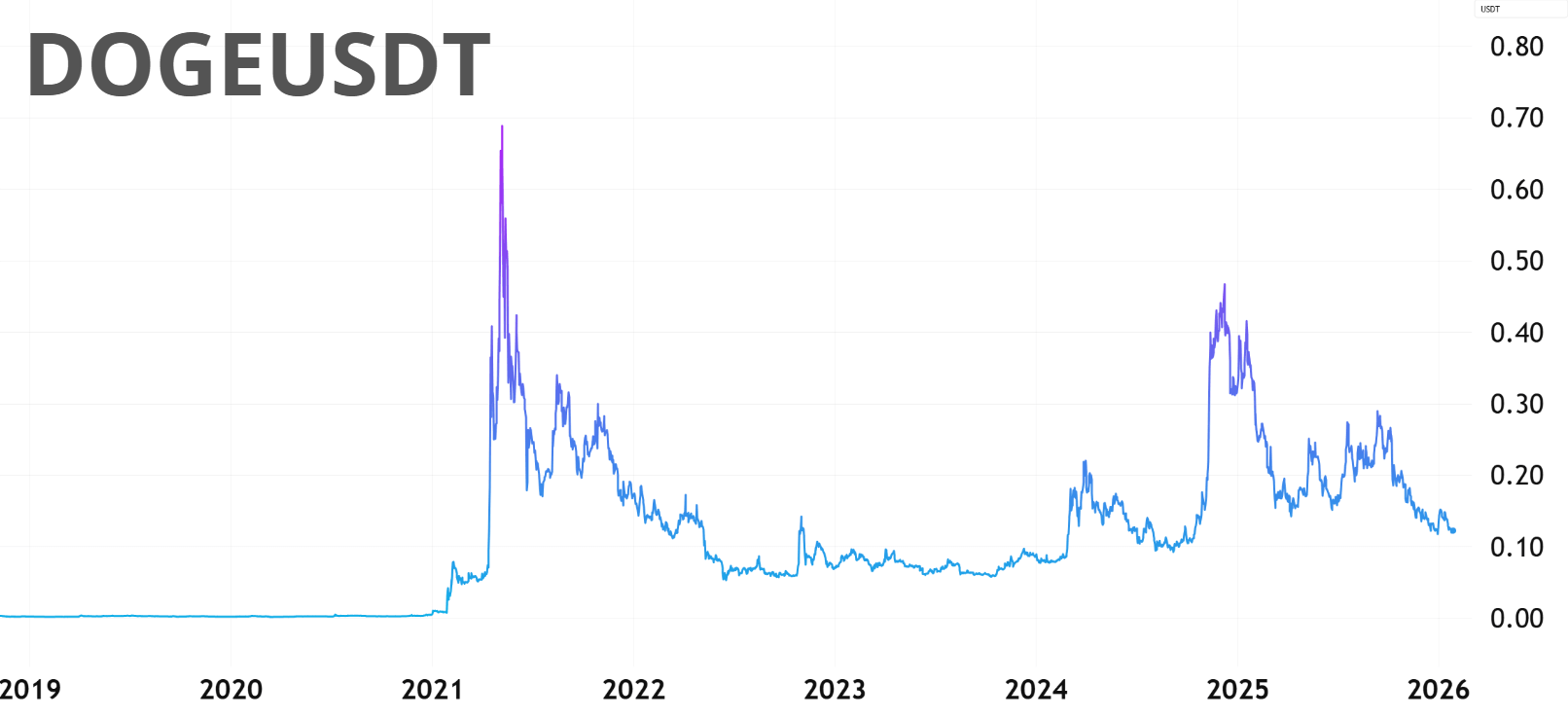
- DOGE traded at fractions of a cent for years, bottoming near $0.0000869 in May 2015.
- The token saw its first major surge, reaching approximately $0.019 during the 2017–2018 cycle.
- In early 2021, DOGE rose over 800% in 24 hours, driven by Reddit activity and endorsements from Elon Musk.
- Price peaked near $0.73 on May 8, 2021, followed immediately by a sharp correction.
- DOGE remained largely range-bound for two years, though it hit a notable local peak near $0.48 in late 2024.
- In early 2026, DOGE is trading between $0.115 and $0.15, struggling to hold above resistance.
Lowest and highest prices yearly, since 2014
Year |
Lowest Price (USD) |
Highest Price (USD) |
Average Price* (USD) |
2014 |
0.0001 | 0.0023 | 0.00026 |
2015 |
0.0001 | 0.0002 | 0.00014 |
2016 |
0.0001 | 0.0005 | 0.00022 |
2017 |
0.0002 | 0.011 | 0.0001 |
2018 |
0.0019 | 0.019 | 0.004 |
2019 |
0.0018 | 0.0049 | 0.002 |
2020 |
0.0011 | 0.0057 | 0.002 |
2021 |
0.0047 | 0.76 | 0.31 |
2022 |
0.05 | 0.22 | 0.05 |
2023 |
0.054 | 0.12 | 0.075 |
2024 |
0.074 | 0.49 | 0.16 |
2025 |
0.091 | 0.43 | 0.21 |
*Average calculated from daily closing prices.
Previous cycles highs and lows
Year |
High |
Year |
Low |
Pullback % |
2014 |
0.0023 |
2015 |
0.0001 | -95.7% |
2018 |
0.0194 |
2020 |
0.0011 | -94.3% |
2021 |
0.76 |
2022 |
0.047 | -93.8% |
2024 |
0.485 |
2025 |
0.091 | -81.2% |
Will Dogecoin (DOGE) ever reach $1?
With a circulating supply of approximately 168.5 billion DOGE, a $1 price would require a market capitalisation of roughly $168.5 billion. Achieving this valuation would elevate Dogecoin to a top-tier crypto asset, rivalling the market presence of Bitcoin and Ethereum while surpassing most other Layer 1 networks.
Reaching the $1 milestone would require an 8-9x increase from early-2026 prices, especially as the network adds roughly 5 billion new coins annually through inflation. Ultimately, such a move would likely depend on:
- An extreme, market wide bull run
- Sustained retail and institutional demand
- Persistent cultural relevance and speculative momentum
While not mathematically impossible, a $1 valuation remains an ambitious and unlikely target under current market conditions and existing forecasts.
Does Dogecoin have a future? Risks and challenges
Future challenges for Dogecoin
Dogecoin remains one of the most widely recognised cryptocurrencies and continues to rank among the top digital assets by market capitalisation. Its long-term outlook, however, depends on whether it can evolve beyond its meme-driven origins.
A central challenges facing the network is the limited pace of protocol development. Compared with newer Layer 1 blockchains, Dogecoin has introduced relatively few technical upgrades and lacks a clearly defined roadmap. It doesn’t feature native support for smart contracts, staking, and advanced cross-chain functionality, and it continues to rely on a proof-of-work consensus model. While community discussions regarding staking and alternative validation mechanisms surface periodically, no confirmed transition plans or timelines have been established.
Utility and ecosystem depth remain equally important. Historically, Dogecoin’s appeal has been driven by cultural relevance and speculative momentum rather than unique functionality. Without meaningful expansion of real-world use cases or faster progress on infrastructure initiatives DOGE risks falling behind more utility-focused networks.
That said, the narrative shifted meaningfully in January 2026 with the launch of the 21Shares Dogecoin ETF (TDOG) on Nasdaq. Endorsed by the Dogecoin Foundation, this product became the first US spot Dogecoin ETF to receive formal SEC approval, marking a major milestone in the asset’s institutional evolution.
Despite this progress, Dogecoin’s inflationary model remains a structural hurdle. This creates persistent downward pressure on the price unless demand expands at the same rate. While supporters argue this fixed issuance makes DOGE better suited for payments than “digital gold” assets, it also limits its appeal as a long-term store of value.
Ultimately, Dogecoin’s future appears shaped more by incremental institutional acceptance and market cycles than by rapid technological change. While the US spot ETF represents a step toward mainstream maturity, long-term sustainability will depend on translating that accessibility into durable, everyday utility.
Dogecoin price predictions 2026-2050
The prices and forecasts displayed in this table and the sections that follow originate from third-party data and aim to offer an overview of current market sentiment.
Source |
2026 |
2027 |
2030 |
2040 |
2050 |
Coincodex |
$0.121 - $0.159 | $0.134 - $0.203 | $0.276 - $0.323 | $0.471 - $0.496 | $0.656 - $0.816 |
Coinpedia |
$0.13 - $1.00 | $1.15 - $1.50 | $2.50 - $3.00 | $14.22 - $25.00 | $55.00 - $155.00 |
DigitalCoinPrice |
$0.12 - $0.18 | $0.12 - $0.21 | $0.20 - $0.27 | $0.32 - $0.39 | $0.54 - $0.58 |
CoinPriceForecast |
$0.18 - $0.20 | $0.21 - $0.24 | $0.37 - $0.39 | * | * |
FinanceShots |
Max $0.76 | $0.84 - $1.08 | $4.12 - $5.21 | $14.39 - $18.86 | $32.44 -$41.25 |
InvestingHaven |
$0.449 - $1.71 | $2.22 | $3.20 | $10.00 | * |
OvenAdd |
$0.56 - $0.71 | $0.91 - $1.10 | $2.01 - $2.21 | $9.28 - $9.73 | $18.98 - $20.42 |
* Price prediction not provided from this source for this year
Forecasts about future performance may not occur.
Dogecoin price predictions for 2026
Forecasts for 2026 remain divided between steady consolidation and a potential breakout. Technical models from CoinCodex and DigitalCoinPrice suggest the price may stabilise between $0.12 and $0.20, largely tracking broader market trends.
However, the January 2026 launch of the 21Shares Dogecoin ETF (TDOG) on Nasdaq has fundamentally shifted the narrative. Bullish analysts at Coinpedia and InvestingHaven view this institutional milestone as a primary catalyst for growth. They project a potential climb toward $1.00 or even $1.71, interpreting the ETF’s approval as a formal validation of Dogecoin’s status as a legitimate asset class and a driver for a significant surge in demand.
Dogecoin price predictions for 2027
Predictions for 2027 reveal a significant divide between conservative and bullish outlooks. Technical models from CoinCodex, DigitalCoinPrice, and CoinPriceForecast remain cautious, projecting a range between $0.12 and $0.24. These forecasts suggest that if Dogecoin continues to follow historical market patterns, it will likely experience slow, steady growth rather than a sudden breakout.
In contrast, bullish platforms such as InvestingHaven, Coinpedia, and OvenAdd project a substantial explosion in value, with targets ranging from $0.91 to a high of $2.22. These aggressive predictions assume that Dogecoin will achieve much wider global adoption, successfully moving past its previous psychological price barriers and institutional hurdles.
Dogecoin price predictions for 2030
By 2030, Dogecoin forecasts are split between two distinct visions of market maturity. Algorithmic models from DigitalCoinPrice and CoinCodex maintain a conservative stance, projecting a range between $0.20 and $0.32. These models suggest that while DOGE will continue to grow, its long-term upside remains tethered to its inflationary supply and typical four-year market cycles.
In contrast, the bullish camp, including FinanceShots, InvestingHaven, and Coinpedia, anticipates a massive breakout, with targets ranging from $2.50 to a peak of $5.21. These aggressive predictions assume a state of "hyper-growth" driven by global adoption and a transition from a meme asset to a dominant digital payment currency. Ultimately, these forecasts suggest that by 2030, DOGE will either settle as a stable, low-cost utility asset or emerge as a primary player in the global payments market.
Dogecoin price predictions for 2040
Approaching 2040, forecasts for Dogecoin reveal a significant divergence. Conservative estimates from platforms like DigitalCoinPrice and CoinCodex project a steady growth range of $0.32 to $0.50, reflecting that Dogecoin's has grown into a stable digital asset and isn’t expected to reach double digits.
Conversely, more optimistic projections from Coinpedia and other bullish analysts envision a big surge, with prices climbing from $10 to over $25. These high-end forecasts are driven by the potential of a fully realized "meme economy" and a global shift toward Dogecoin as a primary transactional currency.
Dogecoin price predictions for 2050
Dogecoin’s future by 2050 continues to present contrasting outlooks. Conservative estimates from DigitalCoinPrice and CoinCodex suggest a gradual increase, projecting values between $0.54 and $0.81. This perspective holds that Dogecoin will remain a niche asset primarily linked to market inflation, rather than a replacement for traditional financial systems.
Conversely, more aggressive forecasts predict a total overhaul of the global financial landscape. Platforms like OvenAdd and FinanceShots project prices between $18 and $41, while Coinpedia offers an extreme scenario with prices ranging from $55 to $155. These extreme projections depend on Dogecoin achieving foundational status as a global currency, driven by total mass adoption and a permanent role in digital culture.
How traders can use Dogecoin forecasts and scenarios
Price predictions help investors, traders, and other market participants better understand and manage price risks. Traders use price predictions to create hedging strategies and make informed decisions about buying or selling assets in financial markets.
Price predictions are speculative, particularly when it comes to long-term price forecasts. Therefore, investors should not use them as their primary source of advice when making investment or trading decisions.
Conclusion
Dogecoin remains one of the most iconic digital assets, but its long-term outlook is a debate between its meme origins and its growing utility. While critics point to its uncapped annual issuance as a limit on scarcity, supporters argue this "fixed inflation" makes it more practical for daily spending than "hoarding" assets like Bitcoin.
Developments like the launch of the first spot Dogecoin ETF (TDOG) and apps that aim to simplify merchant payment can provide a clearer roadmap for real-world use beyond social media hype. However, Dogecoin’s value remains highly sensitive to market cycles and the influence of key figures. Whether it becomes a global payment standard or remains a speculative retail favourite will depend on how successfully these new institutional and technical tools are adopted in the coming years.
Ready to trade your edge?
Join thousands of traders and trade CFDs on forex, shares, indices, commodities, and cryptocurrencies!
References to forecasts and past performance are not reliable indicators of future results.
The images shown are for illustration purposes only. Data is sourced from third-party providers.
This information is for educational purposes only and is not intended to be financial product advice or any investment recommendation. It is not to be construed as a recommendation; or an offer to buy or sell; or the solicitation of an offer to buy or sell any security, financial product, or instrument; or to participate in any trading strategy. It has been prepared without taking your objectives, financial situation and needs into account. Axi makes no representation and assumes no liability with regard to the accuracy and completeness of the content in this publication. Readers should seek their own advice.

Axi Team
The Axi team brings together specialists with decades of experience across every major financial sector. As authors of our expert articles and trading guides, we share insight into forex education, the stock market, and commodities. We use this collective knowledge to provide the practical perspective needed to navigate the markets effectively.
Your capital is at risk.