CFD trading allows traders to speculate on whether the price of an underlying market will rise or fall without owning the underlying asset.
What are CFDs?
A CFD, or Contract for Difference, is a financial derivative that allows traders to speculate on the price movements of an underlying market without owning the underlying asset.
The profit or loss on a CFD position is based on the difference between its opening and closing prices. Traders can take a long position if they expect the price to rise or a short position if they expect it to fall.
CFDs are leveraged products, which means both profits and losses are calculated on the full value of the position rather than only the margin used to open it. You can learn more about how this works in our guide to leverage trading.
CFDs can provide exposure to markets such as forex, shares, indices, cryptocurrencies and commodities, depending on the product and account type.
How does CFD trading work?
When trading a CFD, the trader enters into a contract with a CFD provider to exchange the difference between the opening and closing prices of a position.
CFD markets are normally quoted using two prices: a buy price and a sell price. Which one a trader uses to open a position depends on whether they expect the market to rise or fall.
- Long position: A trader opens a long position when they expect the price of the underlying market to rise. For example, if a trader expects the price of gold to increase, they may buy XAU/USD. If they later close the position at a higher price, the price movement is in their favour. If the market falls instead, the position moves against them.
- Short position: A trader opens a short position when they expect the price of the underlying market to fall. For example, if a trader expects EUR/USD to decline, they may open a short position. If they later close the position at a lower price, the price movement is in their favour. If the market rises instead, the position moves against them.
Traders can read more about taking directional market positions in our guide to speculative trading.
How can traders access the CFD markets?
To trade CFDs, traders need to choose a suitable CFD provider and open an appropriate trading account. Our guide on how to choose a broker covers some of the factors to consider.
CFD providers may use different execution and liquidity models, including market-making, Straight-Through Processing (STP), Direct Market Access (DMA), and ECN-style arrangements. These terms are not always used in exactly the same way by every provider, and the way orders are executed or hedged can vary.
When comparing CFD providers, traders should consider factors such as regulation, execution policy, spreads and commissions, slippage, available markets and risk disclosures.
What's the difference between cash CFDs and futures CFDs?
Cash CFDs and futures CFDs can both provide exposure to movements in an underlying market, but their pricing and contract characteristics differ.
- Cash CFDs: Cash CFDs are generally based on the current cash or spot price of an underlying market. The trader is using a CFD and does not buy, own or take delivery of the underlying asset.
- Futures CFDs: Futures CFDs derive their price from an underlying futures contract. The trader does not own the futures contract or take physical delivery through the CFD. Because the referenced futures contract has an expiry date, rollover may apply when pricing moves to a later contract.
Financing, spreads, rollovers and other trading costs vary by product, so traders should check the current product specifications before opening a position.
For more detail, see our guides to cash vs futures markets and futures trading.
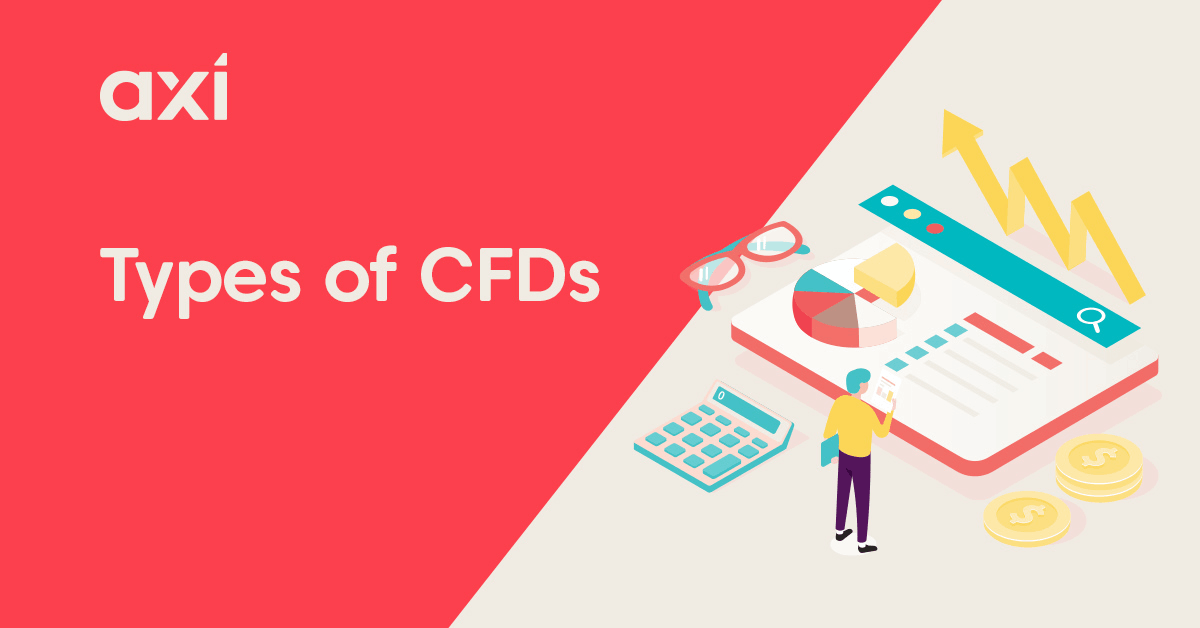
Types of CFDs
CFDs can provide exposure to a variety of financial markets. Explore the CFD instruments available for trading with Axi.
- Forex: CFDs on major, minor and exotic currency pairs. Available pairs may vary by account and region.
- Shares: CFDs based on individual shares of listed companies.
- Indices: CFDs that provide exposure to stock market indices such as the S&P 500, Germany 40 and Nikkei 225.
- ETFs: ETF CFDs allow traders to speculate on the price movements of exchange-traded funds without owning the ETF itself. ETFs can provide exposure to indices, sectors, commodities, geographical markets, or broader investment themes.
- Cryptocurrencies: CFDs based on digital assets such as Bitcoin, Ethereum and other cryptocurrencies available for trading.
- Commodities: CFDs on markets such as oil, natural gas, copper, coffee, cocoa and soybeans.
- Precious metals: CFDs on metals such as gold, silver and platinum.
Trading shares as CFDs
A share CFD allows traders to speculate on movements in the price of an individual company's shares without acquiring ownership of the underlying shares.
When investors buy shares directly, they acquire ownership in the company and generally pay the full purchase price. Their return can be affected by changes in the share price and, where applicable, dividends paid by the company.
With a share CFD, the trader does not acquire the underlying share. Instead, they can take a long position if they expect the price to rise or a short position if they expect it to fall. Both positions can result in losses if the market moves against them.
The prices, margins and trading conditions used in the following examples are hypothetical and provided for illustration only. Actual prices, margin requirements, contract specifications and trading costs may differ.
Share CFD example
Assume Microsoft is trading at $401.00 / $401.30. This means a trader can sell at $401.00 or buy at $401.30.
A trader who expects Microsoft's share price to rise opens a long CFD position at $401.30.
Outcome A: Microsoft shares rise
Microsoft rises to $415.00 and the trader closes the position. The market has moved $13.70 in the trader's favour from the opening price. The actual profit or loss would depend on the position size and applicable trading costs.
Outcome B: Microsoft shares fall
Microsoft instead falls to $390.00 and the trader closes the position. The market has moved $11.30 against the trader from the opening price. The actual profit or loss would depend on the position size and applicable trading costs.
Trading cryptocurrency as CFDs
Cryptocurrency CFDs allow traders to speculate on the price movements of digital assets without owning the underlying cryptocurrency or using a digital wallet.
Because CFDs are leveraged products, the capital used as margin may be smaller than the full value of the position. However, both profits and losses are calculated on the total position size, so leverage also increases risk.
Crypto CFD example
Assume Bitcoin is trading at $70,130 (bid) / $70,160 (ask). This means a trader can sell Bitcoin at $70,130 or buy it at $70,160.
A trader expects Bitcoin to fall and opens a short BTC/USD position at $70,130. They identify $68,000 as a possible lower price level and $71,000 as a level at which they would close the position if the market moves against them.
Outcome A: Bitcoin falls
Bitcoin falls to $68,000. From an opening price of $70,130, the market has moved $2,130 in the direction of the short position. The actual profit or loss would depend on the CFD contract size and applicable trading costs.
Outcome B: Bitcoin rises
Bitcoin instead rises to $71,000. From an opening price of $70,130, the market has moved $870 against the short position. The actual profit or loss would depend on the CFD contract size and applicable trading costs.
Trading indices as CFDs
An index tracks the performance of a defined group of securities, with its value calculated according to the methodology of that particular index. Some indices are weighted by market capitalisation, while others use different weighting methods.
When trading an index CFD, the trader gains exposure to movements in the index without buying the individual shares that make up the index.
Popular examples of stock market indices available through CFDs can include:
- ASX 200
- DAX 40
- FTSE 100
- Nasdaq 100
- US500
- US30
- Nikkei 225
Index CFD example
Assume a trader holds a portfolio containing technology shares such as Amazon, Google, Nvidia, Meta and Tesla, but expects the technology sector to weaken over the short term.
The trader could open a short position on an index CFD such as USTECH, which is based on the Nasdaq 100. If the index falls, the short CFD position moves in the trader's favour. If the index rises, the CFD position moves against them.
An index CFD position will not necessarily offset movements in an individual share portfolio because the composition, weighting and price movements of the portfolio may differ from those of the index.
Trading gold as CFDs
Gold is one of the world's most widely traded precious metals and has historically been used as a store of value and portfolio diversifier. Traders can use gold CFDs to speculate on changes in its price without owning physical gold.
XAU/USD represents the price of gold against the US dollar. Gold and other precious-metal CFDs may be available through spot and futures-based markets, depending on the instrument.
Gold CFD example
Assume XAU/USD is trading at $2,350.00 / $2,350.50 and a trader expects the price of gold to rise. The trader opens a long CFD position at $2,350.50.
Outcome A: Gold rises
If gold rises to $2,360.50, the market has moved $10.00 in the trader's favour from the opening price. The actual profit or loss would depend on the position size and applicable trading costs.
Outcome B: Gold falls
If gold instead falls to $2,340.50, the market has moved $10.00 against the trader from the opening price. The actual profit or loss would depend on the position size and applicable trading costs.
Trading oil as CFDs
Oil CFDs allow traders to speculate on movements in oil prices without buying, storing or taking delivery of physical oil.
Crude oil is an important global commodity used across industries including transportation, manufacturing, chemicals and energy. Its price can be affected by factors such as global supply and demand, economic conditions, production decisions and geopolitical developments.
Oil CFDs may reference either cash prices or futures prices:
- Oil cash CFDs: These CFDs reference the cash or spot price of oil. Traders speculate on price movements without buying or taking delivery of physical oil.
- Oil futures CFDs: These CFDs derive their price from an underlying oil futures contract. Traders do not own the futures contract or take physical delivery through the CFD, although rollover may apply when the referenced futures contract approaches expiry.
Oil CFD example
Assume USOIL is trading at 102.50 / 102.53 and a trader expects the price to rise. The trader opens a long cash CFD position at 102.53.
Outcome A: Oil rises
USOIL rises to 102.90 and the trader closes the position. The market has moved 0.37 in the trader's favour. The actual profit or loss would depend on the CFD contract size and applicable trading costs.
Outcome B: Oil falls
USOIL instead falls to 102.20 and the trader closes the position. The market has moved 0.33 against the trader. The actual profit or loss would depend on the CFD contract size and applicable trading costs.
As a futures CFD example, assume an oil futures CFD is trading at 101.25 / 101.30 and a trader opens a short position at 101.25 because they expect the price to fall.
If the CFD price falls to 98.00, the market has moved 3.25 in the direction of the short position. If it instead rises to 102.00, it has moved 0.75 against the position. The actual profit or loss would depend on the contract size and applicable trading costs.
Ready to trade your edge?
Join thousands of traders and trade CFDs on forex, stocks, indices, commodities, and cryptocurrencies.
This information is not to be construed as a recommendation; or an offer to buy or sell; or the solicitation of an offer to buy or sell any security, financial product, or instrument; or to participate in any trading strategy. It has been prepared without taking your objectives, financial situation, or needs into account. Any references to past performance and forecasts are not reliable indicators of future results. Axi makes no representation and assumes no liability regarding the accuracy and completeness of the content in this publication. Readers should seek their own advice.
FAQs
Futures contracts and CFDs have unique characteristics.
Futures contracts:
- Have an expiry date (meaning each contract has a fixed expiry date, and a new one will be created after that)
- Are traded on a centralised and regulated exchange, offer leverage, but require more margin
- Are standardised products and offer less flexibility
- Theoretically, ownership of the asset can be assumed after the expiry of the date, but this is rarely the case in speculative trading
CFDs:
- Traders never own the underlying asset
- Traders can utilise high leverage and margin requirements are low
- CFDs are an agreement between traders and the broker the traders are using (over-the-counter transaction)
- CFDs can be traded in small contract sizes (for example 0.01 lot size)

Milan Cutkovic
Milan Cutkovic is an experienced trader and market analyst specializing in forex, indices, commodities, and stocks. He was one of the first traders accepted into the Axi Select program, which identifies talented traders and supports their professional development.
He is passionate about helping others improve their trading skills through educational articles, eBooks, and content published on the Axi blog. His work is regularly featured and quoted in major international media outlets, including Yahoo Finance, Business Insider, Barron's, CNN, Reuters, New York Post, and MarketWatch.